Deliberative focus groups in Czechia: the mutuality of facilitated discussions and how to combat conspiratorial thinking
Last year in April, Work Package 6 (WP6) held several deliberative focus groups about climate justice activism in Czechia. The participants were presented with different protest scenarios and voted on the 'worst' one. Then, with guidance from facilitators, participants were asked to redesign the protest scenario so that it would meet their ideas and radical imaginaries. The facilitators focused the discussion on emotional experiences of the protest events, and through reflexive questions guided the participants so that a concrete idea of a protest event was formulated towards the end of the discussion.
The 'deliberative' in the deliberative focus group ties this methodological approach to deliberative democracy practices. Deliberative democracy is a democratic approach firmly grounded in the idea that a representative sample of the target population is able to solve problems to maximise satisfaction of the community (target population) in question. Given enough time, resources, information provided, and decision-making power, deliberative democracy has been successfully employed for various local projects. Its core principles are diversity (ensured by the representative sample), consensus building (ensured by facilitators), and information gathering (with dedicated time in the programme). We call the focus groups organised by WP 6 deliberative because they employ these three elements.
In total, we organised 6 focus groups with representative samples of people and gender as a control variable. We conducted all-male, all-female, and mixed-gender focus groups, based on self-declared gender, which were representative with regard to age and education. We organised these groups in two locations, one urban, prosperous, and the other industrial, deprived. Each location held a set of three focus groups. Based on this experience, I would like to offer some general takeaways on deliberative research methods, gender group dynamics, and the urban/industrial divide from the perspective of our facilitators, articulated immediately after the sessions.
Surprise over the "ability to agree"
First, overwhelmingly in all groups in both locations, people have been surprised by the ability to agree and build consensus within their group. This was often articulated as a positive experience, which they did not expect. In the groups that included men, this was usually articulated in contrast to activists, suggesting that everyone was "thrilled" that they actually agreed, thrilled that there were no "crazy activists" there. The idea that activists are "crazy" was generally very pronounced in the all-male groups. Not only crazy, but often it was also suggested they got "paid" to do their activism - but definitely either outrageous or entertaining to watch. One of the facilitators explained: "And there was even the idea that it was a shame they didn't have someone like an environmental radical there with whom they could entertain themselves and hear his arguments. Not too many, just one. If there were more of them, then no." I interpret this as a positive experience because of the guidance of the facilitators and the focus on consensus-building.
Secondly, conspiracy thinking carried through the groups that included men.
Facilitator 1 (mixed gender group): "There was one guy who was clearly spreading disinformation. And at one point, he infected the rest of the group with the idea that all activists are paid."
Facilitator 2 (all-male group): "Everyone was paid according to our group too. But in our group, that's a given."
This was a radical difference from the all-female group, where no conspiracies flourished, and everyone was focused on completing the task at hand - that was, redesigning the protest scenario.
People left feeling optimistic
The way in which these deliberative focus groups were designed, provided no mechanism or space to correct the conspiratorial thinking. With the meticulous work of facilitators who kept redirecting the attention of the group to the task at hand, eventually, all groups came up with a climate justice event scenario, so the conspiratorial thinking did not derail the goal of the discussion. However, for a higher-stakes decision-making than designing a protest event for research purposes, certain mechanisms to combat the spreading of conspiratorial thinking should be put in place. It should not be on the shoulders of facilitators, because intervening in the discussion while guiding it would disturb the process and take power away from participants. However, in deliberative democratic processes, the phases of information gathering and consensus-building discussions often repeat multiple times and follow one another. Perhaps this could be a potential mechanism that would allow corrective messages to enter the discussion without the need for the facilitator to step outside of their role.
Overall, based on the reflections of our facilitators, deliberation seems to be a useful tool to course correct the notion that people are polarised to the extent that they cannot hold a conversation or agree on anything. All the participants articulated that they left feeling more optimistic about the state of society, because they could agree with strangers on certain things, and some participants, mostly from the all-female group, felt hopeful about the future of climate activism.
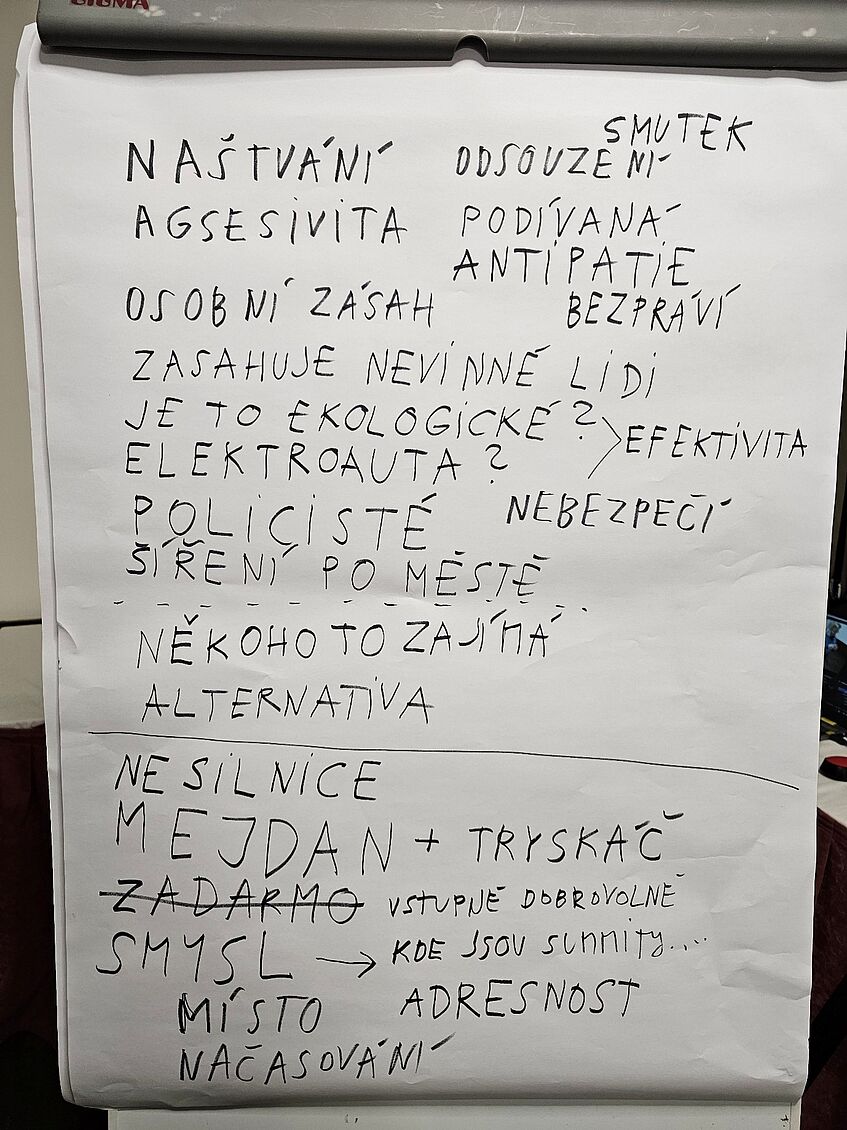
© Linda Coufal
Flipchart with notes in Czech from deliberative focus groups. It says from up down, left to right: anger, sadness, condemnation, aggression, show, personal intervention, antipathy, lawlessness, it impacts innocent people, is it ecological? Electric cars? > efficiency, policeman, danger, spreading around the city, ---- somebody cares, alternative, ______ no roads, party + jet plane, free, entry fee voluntary, meaning -> where are the summits…, place, targeted, timing
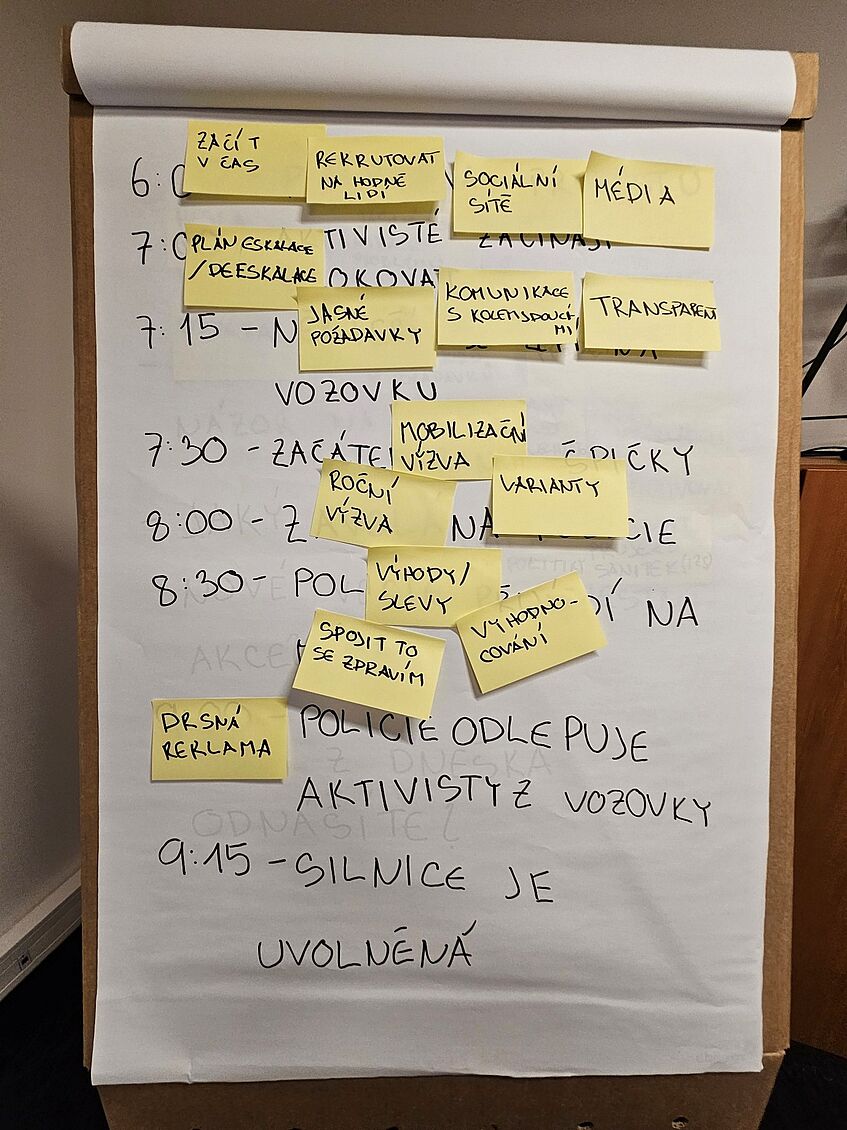
© Linda Coufal
Flipchart with notes in Czech from deliberative focus group. Timeline of the “worst” protest in the background. On post-it notes are ideas for the ideal protest event. They say from top to bottom, left to right: start on time, recruit many people, social media, media, plan to escalate/deescalate, clear demands, communication with passers by, transparency, call for mobilization, year-long challenge, variants, benefits/discounts, evaluation, connect it to health, hard marketing.
Linda Coufal is a coordinator of field work in WP6 and a PhD. candidate at the Faculty of Social Sciences of Charles University. Their research focuses on conservative social movements and their intersections with gender, populism, and misogynist extremism.