From Bratislava to Shanghai: On the Twin Transformation, Up Close
From Bratislava to Shanghai: On the Twin Transformation, Up Close
Most of the time, my research on the automotive industry happens at a desk in Bratislava or in a meeting room inside or near a plant gate somewhere in a Central European country. In late June 2025, it took me considerably further east to the 33rd International Colloquium of GERPISA, hosted by the School of Economics and Management at Tongji University in Shanghai under the theme "The Central Role of China in the Global Automotive Industry".
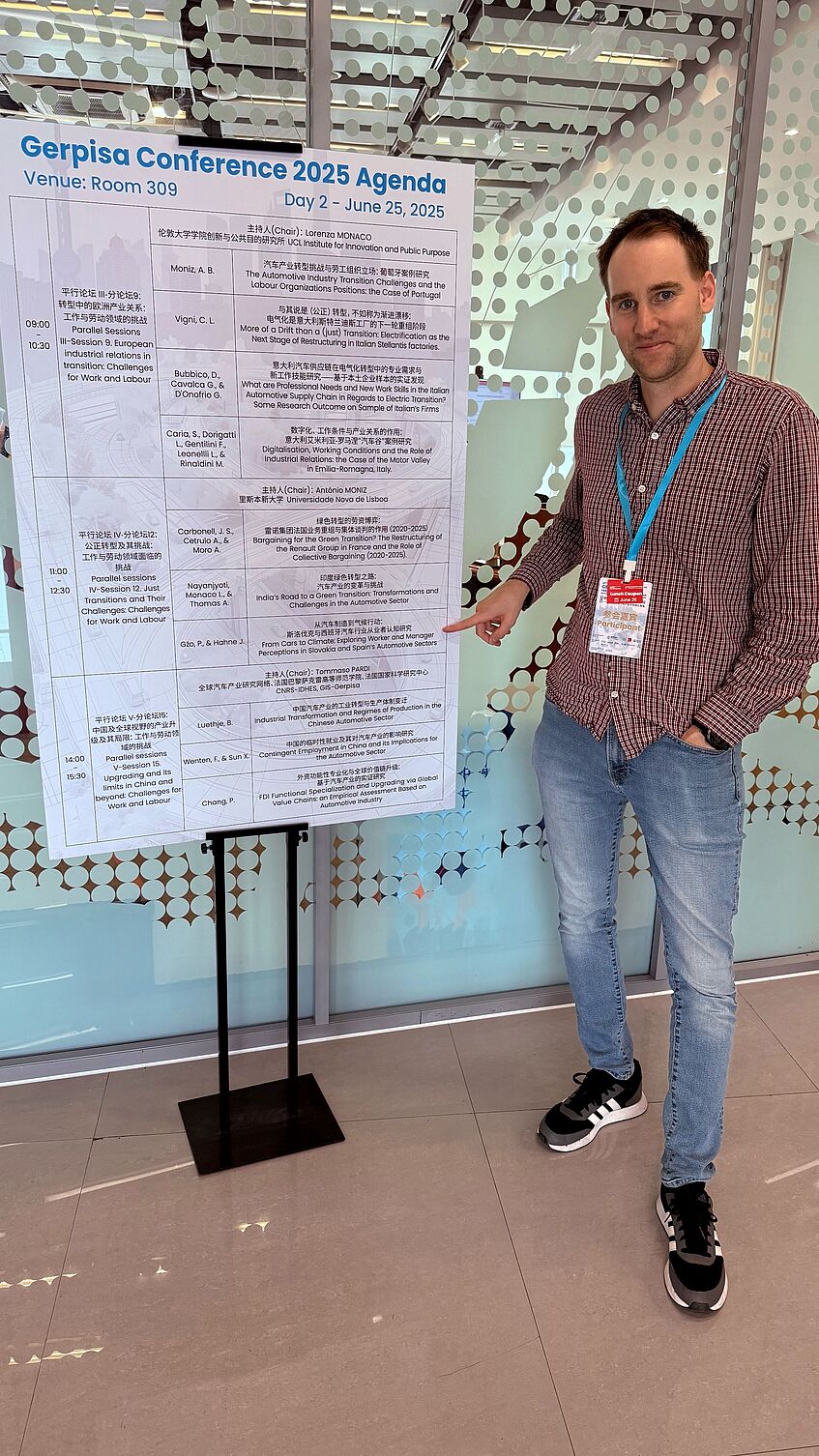
I went to present a paper co-authored with Janina Hahne titled "From Cars to Climate: Worker and Manager Perceptions in Slovakia and Spain's Automotive Sectors" which grew out of our fieldwork in the CIDAPE project. The paper asks a fairly local question: how do skilled workers and middle managers in two European auto economies experience the so-called twin transition (decarbonisation and digitalisation) in their plants and in their everyday lives? Travelling with that question to Shanghai produced a useful disorientation.
© Patrik Gažo
The Silent Streets of Shanghai
What struck me first, before any of the panels, was the silence. Shanghai's streets are quieter than I had expected because they are full of electric vehicles. China's industrial policy has actively pushed in this direction. In several cities, registration plates for combustion-engine cars cost considerably more than plates for EVs. The effect on the ground does not read as a lifestyle being attacked. It reads as a city deciding to clean its air and as an industrial strategy aligned with that decision rather than negotiating against it. After years of listening to European workers and managers describe electrification as something done to them, the contrast was hard to miss.
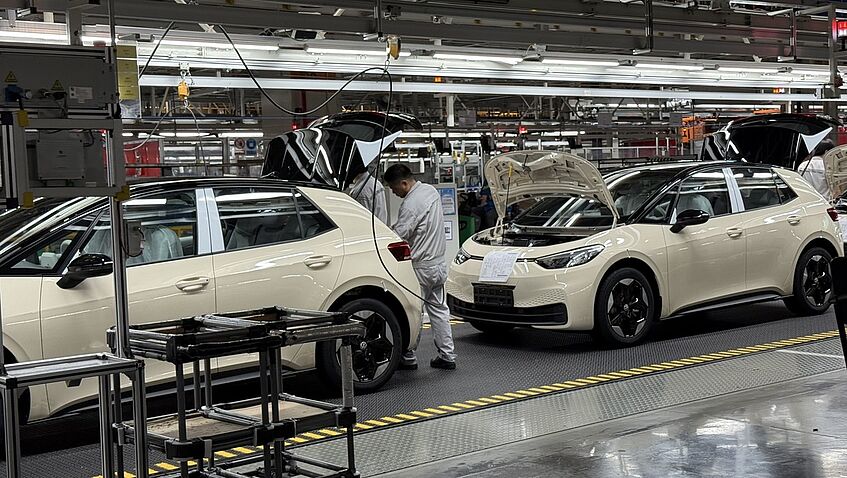
One of the colloquium's side activities took me to a SAIC-Volkswagen (VW) plant near Shanghai which was in the middle of a reconstruction for new models. Unexpectedly, cameras were allowed inside, precisely because the line was being reorganised. Many of the workers who normally staffed it had been relocated for the duration of the works to another VW facility several thousand kilometres away. The German managers we spoke to described this as a smooth, even cheerful operation: workers had moved willingly, families and all, and the schedule was holding. What struck me was not the plausibility of the story but its distance from anything I could imagine in the European plants I study. A relocation of that scale and duration would be a major negotiation in Slovakia or Spain, if it were to happen at all. In China, by contrast, it appeared as a routine matter of operational logistics. Similar EV models are being built in both contexts but against very different labour regimes and different relationships between work and mobility.
Our paper draws on two cases that share exposure to the same regulatory horizon and the same competitive pressure from precisely the manufacturers that filled the agenda in Shanghai. What divides them is almost everything else: industrial-relations history, union density, the structural position each country occupies in the European production system, the gendered and migrant composition of the workforce, and the politics of just transition.
© Patrik Gažo
Mistrust towards Climate Policy in Europe
The argument we tried to make is that climate policy does not arrive in these plants as a neutral technical update. It arrives as a force that reshapes job quality, skill demands, and workplace relations, and people on the shop floor interpret it accordingly. In Slovakia, as an "integrated periphery" of the European auto industry, the transition tends to be experienced as a downgrading: fears of layoffs as EV production absorbs fewer workers, training that often amounts to learning on the fly, an increase of agency and migrant labour on the line, and a sense that decisions arrive from corporate headquarters elsewhere. In Spain, the same global process registers more as a subdued resignation: less fear of immediate job loss but a quiet sense that environmental regulations are imposed rather than co-created, and that the benefits of electrification (the cars themselves, the charging infrastructure) are concentrated in urban centres that many workers do not live in.
What our interviewees in both countries share is mistrust. Across Slovakia and Spain, workers and managers tend to understand climate policy as driven by reputation management or political positioning rather than by ecological substance. And this is where Shanghai produced the strongest echo: both Slovak workers and Slovak managers regularly invoke "the Chinese" as a competitive horizon, sometimes admiringly, often anxiously, occasionally as the reason why European overregulation will "push production to Asia". Standing in a room where that horizon was no longer abstract was a useful corrective. The climate boundaries we research in work package 4, the everyday lines people draw between "us" and "them" when talking about climate, mobility and work are not just local artefacts. They form in conversation with imaginaries of distant actors who, on a Tongji campus afternoon, did not feel distant at all. The trip also gave me a small lesson in being on the other side of one of those lines: in some of the cities I passed through, I was the one who was considered "the other", visibly different, occasionally an object of curiosity, but never excluded. Different and excluded, I was reminded, are not the same thing.
© Patrik Gažo
Different Perspectives on "Clean Mobility"
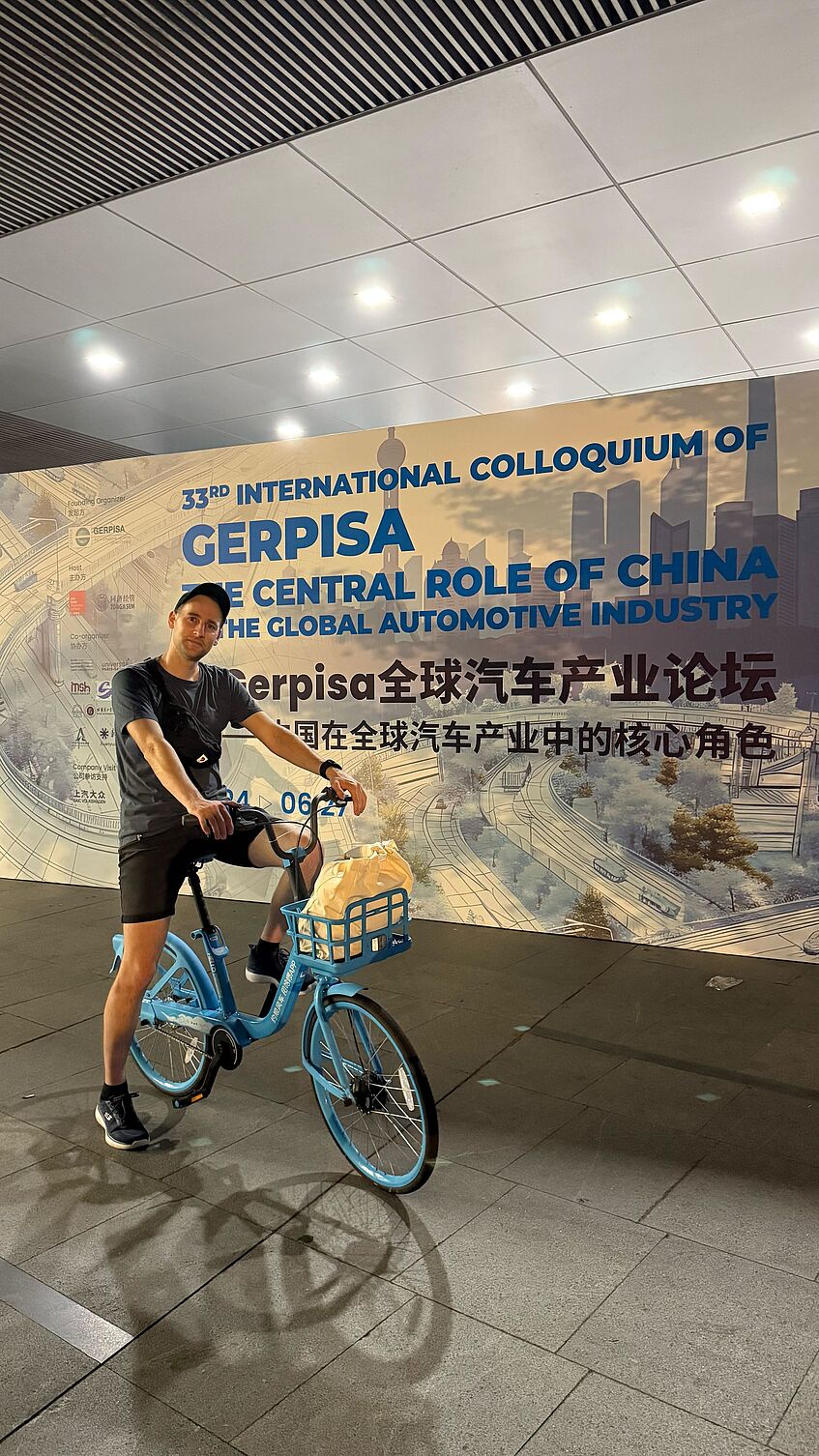
For getting around, I leaned more than expected on Shanghai's shared bikes, which are cheap, ubiquitous and embedded in cycling infrastructure that genuinely works. The blue HelloBike (see picture) became my main commute. Combined with the metro, it was a small ground-level demonstration that "clean mobility" can be built into a place rather than only legislated onto it.
What stays with me from Shanghai is not a single argument but a recalibration of distance. The twin transformation looks one way from a Slovak assembly line, another way from a Spanish provincial plant, and different again from the city in a country that, more than any other, is currently authoring it. For our work in CIDAPE, the lesson is that the way European workers feel about electrification is shaped not only by their managers, unions, or governments, but by a global picture they only partially see. Part of our job is to take that picture seriously without flattening the texture of what people actually live.
Patrik Gažo is a research fellow at the Institute for Sociology of the Slovak Academy of Sciences (SAS) and at the Central European Labour Studies Institute (CELSI) and a researcher in CIDAPE's work package 4. He explores the tensions between working-class interests and environmental concerns, analysing their implications for addressing environmental and climate crises.